Parks on the Air: So, You Found an Activation. Now What?

A personal journey into Parks on the Air

So, you’ve done it.

You found a POTA activation on POTA.app. You figured out what that little spot notification means, found the frequency, looked up the park, and maybe even realized the activator is somewhere relatively close.

Now comes the part where you actually have to talk to them.

Don’t worry. This is amateur radio. There are procedures for everything, most of which can be made considerably more complicated than necessary.

The good news is that working a POTA activation isn’t difficult.

The trick is learning how to listen before you transmit.


The Most Important Piece of Equipment

Before we talk about radios, antennas, batteries, coax, portable masts, tuners, power supplies, or any of the other equipment we’re going to convince ourselves we absolutely need to take into the park, let’s talk about the most important piece of equipment you’ll bring with you.

Your ears.

Or, more accurately, your ability to listen.

I know. That’s not nearly as exciting as talking about a new radio.

But if you’re going to hunt POTA activations, learning to listen is probably going to make a bigger difference than buying another hundred dollars’ worth of equipment.

When you find an activation, the temptation is to immediately grab the microphone and throw your callsign into the pile.

Don’t.

Listen first.

Find the activator’s frequency and spend a few seconds figuring out what’s happening.

Are they calling CQ?

Are they already working another station?

Is there a pileup?

Are they asking for a particular state, country, callsign prefix, or something else?

And, most importantly, what is the activator actually asking for?

The frequency isn’t going anywhere.

Well, hopefully it isn’t.

If the activator is already talking to someone, wait.

If twenty stations are calling at once, don’t become number twenty-one just because you can.

Listen for the rhythm.

Eventually, you’ll hear the activator finish a contact, pause, and start listening again.

That’s your opening.

Give your callsign clearly, once.

Then listen.

You may get picked immediately.

You may not.

And that’s okay.

Because the goal isn’t to be the loudest station in the pileup.

The goal is to be the station the activator can actually hear.


Welcome to the Pileup

Eventually, you’re going to hear something that sounds less like a radio conversation and more like somebody kicked an angry beehive.

Congratulations.

You’ve found a POTA pileup.

An activator announces that they’re operating from a park, and suddenly operators from all over the place are trying to work them.

Sometimes it’s five or ten stations.

Sometimes it’s thirty or forty.

And sometimes it sounds like every licensed amateur radio operator on the planet just happened to be sitting in front of their radio at the same time.

The activator might say:

“CQ POTA, CQ Parks on the Air, this is KF5WZD.”

And then you’ll hear:

“K5ABC!”

“W4XYZ!”

“N0WHO!”

“KF7SOMETHING!”

“ME! ME! PICK ME!”

Okay, nobody actually says “me, me, pick me.”

Usually.

When you’re new to POTA, a pileup can sound completely chaotic. It can be difficult to tell who’s talking, what the activator is saying, or whether you should even try to get in there.

But there is a rhythm to it.

The activator calls CQ.

Several stations respond.

The activator picks out a callsign.

That station gives their report.

The activator confirms the contact.

Then the activator listens for the next station.

And the whole thing starts over.

Once you recognize that rhythm, the pileup becomes much easier to understand.

More importantly, you start to realize that you don’t have to fight your way through the entire crowd to make a contact.

You just have to find the right moment to speak.

And sometimes, the best thing you can do in a pileup is absolutely nothing.

Just listen.

Because the activator may be doing something you haven’t figured out yet—working a particular part of the country, listening for a specific callsign prefix, or simply trying to pull one clean callsign out of the noise.

Pay attention to what they’re asking for.

Then, when the opportunity presents itself, that’s when you make your move.

Not before.

Not louder.

Not five times in a row.

Just at the right time.


Don’t Call Over Someone Else

Here’s another big one.

If the activator is already talking to somebody, don’t transmit over them.

It sounds obvious, but when you’re sitting there watching the spot and you’ve been waiting five minutes to work the park, your brain starts whispering things like:

“Maybe if I just yell really loud…”

Don’t.

The activator can’t work you if they can’t hear you.

And if you transmit over the station they’re currently working, all you’ve accomplished is making it harder for everyone—including yourself—to hear the contact.

Wait for the conversation to finish.

Then listen for the opening.


You Don’t Have to Shout

When you’re in a pileup, there is no advantage to being the loudest person on the frequency.

In fact, shouting your callsign repeatedly can make you less likely to get picked.

Try something simple.

Listen.

Find the rhythm.

Wait for the activator to finish.

Then give your callsign once, clearly.

For example:

“KF5WZD.”

That’s it.

No need for:

“KF5WZD, KF5WZD, Kilo Foxtrot Five Whiskey Zulu Delta, Kilo Foxtrot Five—”

You get the idea.

The activator heard you.

Or they didn’t.

If they didn’t, there will be another opportunity.


The Activator Is Listening for You

One thing that’s easy to forget when you’re on the hunting side of a POTA contact is that the activator has a completely different job.

You’re trying to get one contact.

They’re potentially trying to make dozens or even hundreds.

That means the activator is listening for callsigns while simultaneously keeping track of who they’ve already worked, giving reports, watching their equipment, dealing with the weather, and probably trying not to sit on an ant hill.

Give them a little help.

When they come back with something like:

“Whiskey Five…?”

Don’t immediately assume they’re talking to you.

Listen to see if they finish the callsign.

If they say:

“Whiskey Five Alpha Bravo?”

and you’re W5ABC, congratulations. You might have just won the POTA lottery.

Come back with your callsign clearly.

If they say something completely different, let it go.

There’s always another contact.


What About the Report?

For most POTA contacts, the exchange is wonderfully simple.

You give the activator your callsign and a signal report.

The activator gives you their callsign and a signal report.

That’s usually it.

For example:

Activator:
“KF5WZD, you’re 59.”

You:
“You’re 59 as well. Thanks for the park!”

And you’re done.

You don’t need to tell the activator about your antenna project.

You don’t need to explain that your radio is sitting on the kitchen table.

You don’t need to give them your complete life story.

And you definitely don’t need to explain how you once worked a station from Antarctica in 1987.

There may be a time for that conversation.

A POTA pileup generally isn’t it.

Keep the exchange short and let the activator keep moving.


And Yes, You Can Spot Them

Once you’ve successfully worked the activator, you may be tempted to immediately post another spot.

That’s where a little judgment comes in.

If the activator’s frequency is already properly spotted and they’re actively working stations, they probably don’t need you to do anything.

But if the activator has moved to a new frequency and isn’t showing up on the spotting system, a new spot can be extremely helpful.

Remember what we talked about in Article 2:

Spots are information.

A good spot helps other operators find the activation.

A bad or unnecessary spot can create confusion.

Before posting one, make sure you actually know where the activator is operating.

And please don’t spot an activator on a frequency where you think they might be.

You’d be surprised how quickly several dozen hams can arrive at the wrong frequency.

It’s basically a ham-radio version of following the wrong GPS directions.


What If You Miss Them?

This is going to happen.

You will hear the activator.

You will call them.

They won’t hear you.

You’ll call again.

Still nothing.

Someone else gets the contact.

You’ll try again.

Someone else gets it.

Eventually you’ll start wondering if the activator has personally decided that your callsign is offensive.

They haven’t.

There are a lot of variables involved.

Your signal might be weak at their location. Their signal might be weak at yours. Propagation may be changing. There may be interference. There may be twenty other stations calling at the same time.

Take a breath.

Listen.

Try again when there’s an opening.

And if you never make the contact?

That’s radio.

Move on to the next one.

There will be another activation.


You’re Going to Make Mistakes

You’re going to jump in too early.

You’re going to mishear a callsign.

You’re going to transmit over somebody.

You’re going to miss the activator completely.

You’re probably going to forget the exchange halfway through your first pileup.

And eventually, you’re going to realize you’ve been calling a station that isn’t even there anymore.

Congratulations.

You’re doing POTA.

The important thing is to learn from it and keep going.

Nobody started out knowing how to work a pileup.

The operators who make it look easy have simply spent more time listening to them.


Keep It Simple

If there’s one theme running through this entire series, it’s going to be this:

Keep it simple.

You don’t need to know everything before you make your first POTA contact.

You don’t need to understand every feature of POTA.app.

You don’t need to know every operating procedure in amateur radio.

And you certainly don’t need to own every piece of equipment advertised in the latest ham-radio catalog.

Start by finding an activation.

Listen.

Learn the rhythm.

Wait for your opportunity.

Give your callsign clearly.

Make the contact.

Then do it again.

Before long, you’ll find yourself sitting in front of the radio listening to a pileup and thinking:

“I know exactly what’s happening here.”

And that’s when things start getting really fun.

Because eventually, you’re going to stop hunting parks…

…and you’re going to decide it’s time to activate one yourself.

That’s where we’re headed next.

In Article 4, we’ll leave the comfortable confines of the shack and start talking about what it actually takes to get a radio into a park—radios, antennas, batteries, coax, portable masts, tuners, and all the other stuff you will swear you’re going to keep to a minimum.

You won’t.

But we’ll talk about it anyway.

Get Outside, Get On the Air, Get in the Park, but most importantly, HAVE FUN and Keep it Simple!!

73
KF5WZD – Chris
Article 2: You Found a POTA Activation—Now What?

A Personal Journey Into Parks on the Air

Last night, I got to experience Parks on the Air from the other side of the pileup.

I was sitting at Columbus Lake, operating US-7129, with a radio, antenna, battery, and enough equipment scattered around me to make anyone walking by wonder exactly what I was building.

I wasn’t looking for a POTA activator.

I was the POTA activator.

By the time I packed everything up, I had made more than a hundred contacts with operators all over the country and beyond.

And while I was sitting there working stations, I started thinking about what it must look like from the other side.

You find a POTA spot.

You tune to the frequency.

You hear a bunch of people calling.

Now what?

That’s what this article is about.

Last Night, I Was the Guy You Were Looking For

This is where my Columbus Lake activation gave me a completely different perspective.

Once I started calling CQ, the spots started doing their job.

Operators began finding me.

Some stations were incredibly strong.

Some were weak.

Some came through clearly.

Others were buried underneath the noise.

And sometimes several stations were calling at once.

From my side of the radio, I could tell pretty quickly which operators had a good handle on the situation.

The ones who waited for an opening, gave their callsign clearly, and followed the flow of the activation generally made things much easier.

And that doesn’t mean you need to sit there for five minutes studying the frequency before making a call.

Sometimes you hear the activator, hear an opening, give your callsign, and boom—you’re in the log.

That’s the goal.

Being on the activator side also made something else very clear:

The people trying to contact you don’t know what is happening at your end of the radio.

They don’t know if you’re hearing them.

They don’t know if you just worked somebody else.

They don’t know if you changed frequencies.

They only know what they can hear.

So understanding how a POTA activation works from the activator’s side can make you a much better hunter.

And that’s where we start.

Finding a POTA Activation

The easiest place to start is POTA.app.

POTA.app is where you’ll find current POTA spots and information about activations.

A typical spot will give you the activator’s callsign, park reference and name, frequency, operating mode, and when the station was spotted.

Think of it as someone saying:

“Hey, I hear this POTA station over here!”

For example:

KF5WZD — US-7129 — 14.285 MHz — SSB

That tells you someone has heard KF5WZD operating from Columbus Lake on or around 14.285 MHz using single sideband.

Pretty simple.

Just remember that a spot is a snapshot in time, not a live tracking device.

The activator may have moved frequencies, changed bands, taken a break, or even finished the activation.

So if the spot says 14.285 MHz, don’t assume the activator is still sitting there waiting for you.

Use the spot to get you in the neighborhood.

Then see what’s happening on the frequency.

The Spot Says 14.285 MHz. Now What?

Tune to the frequency and see what’s happening.

Maybe you’ll hear the activator calling CQ.

Maybe you’ll hear a pileup.

Maybe you’ll hear the activator working stations one at a time.

Maybe you’ll hear absolutely nothing.

That last one happens too.

The spot might be a few minutes old, or the operator may have already moved.

If you hear the activator, take a moment to figure out how they’re handling contacts.

If they’re working stations one at a time, you’ll know what to expect when it’s your turn.

If they’re asking for specific areas or states, pay attention to that, too.

You’re not trying to memorize a complicated procedure.

You’re simply figuring out how this particular operator is running the activation.

What If Everyone Is Calling at Once?

Welcome to the POTA pileup.

One minute the activator is calling CQ and the next minute it sounds like somebody dropped a box of radios down the stairs.

Everyone wants the contact.

And honestly, that’s part of the fun.

The trick is not to become the Loudest Human Being on the Frequency™.

If several stations are calling at once, don’t try to transmit over everyone else.

Look for an opening.

Sometimes the activator will pick out a callsign.

Sometimes they’ll ask for a state, region, or prefix.

Sometimes the pileup will suddenly quiet down for half a second.

That’s your opportunity.

And if they don’t hear you the first time?

No big deal.

Try again when there’s another opening.

POTA isn’t a competition to see who can yell the loudest into a microphone.

Although, judging by some pileups, there are definitely people willing to compete.

What Do I Say When They Call Me?

This is one of the questions that comes up pretty quickly when you’re new to POTA.

You finally get through the pileup.

The activator comes back with your callsign.

And suddenly your brain decides that every word you’ve ever learned has left the building.

Relax.

It’s usually pretty simple.

Something like:

“KF5WZD, you’re five-nine.”

The activator may come back with their own callsign or simply acknowledge you.

You might respond:

“Five-nine, thanks!”

And you’re done.

You don’t need to give the activator your complete station description.

You don’t need to explain your antenna.

You probably don’t need to tell them that you’ve owned your radio for three years but only figured out how to turn it on last Tuesday.

Keep it simple.

Make the contact and let the activator move on to the next station.

We’ll go into this much deeper in the next article, including signal reports, callsigns, mistakes, and what happens when the activator doesn’t quite copy you correctly.

There’s More Than One Way to Find an Activation

Active spots aren’t the only way to find POTA activity.

POTA also allows operators to schedule activations.

A scheduled activation is essentially an operator saying:

“I’m planning to be at this park around this time.”

And that word planning is important.

Weather happens.

Batteries happen.

Antennas happen.

Cars develop opinions.

And sometimes life simply gets in the way.

That means a scheduled activation isn’t a guarantee that someone will actually be on the air.

But it does give hunters another way to find parks and operators that might otherwise never cross their radar.

If there’s a particular park you’ve been wanting to work, scheduled activations can be a great place to start.

Once You Make the Contact, You’re Done… Right?

Technically?

Yes.

You made the contact.

Log it.

Smile.

Find another park.

But there’s another useful thing you can do.

If you’re hearing an activator clearly and you’re confident the frequency and mode are correct, you can spot—or re-spot—the station.

That helps other hunters find the activator.

You’re essentially telling everyone else:

“Hey, this station is still here.”

Just make sure the information you’re posting is accurate.

Otherwise, you may send a bunch of hunters marching toward an empty frequency.

And now you’ve just created a convoy heading toward an empty parking lot.

Don’t Become Completely Dependent on the Spotting Website

POTA.app is an excellent tool, especially when you’re getting started.

But POTA stations can also turn up when you’re not looking for them.

You might be tuning across a band and hear:

“CQ POTA…”

You might hear someone mention a park on a local repeater.

Or you might stumble across a strong signal and suddenly realize:

“Wait a minute… Is that a POTA station?”

That’s part of the fun.

The spotting system makes finding activations much easier.

It doesn’t mean you have to stare at a website waiting for the next little green dot to appear.

Sometimes the best contacts are the ones you weren’t expecting.

Your First POTA Hunt

If you’re sitting at your radio wondering where to start, here’s the basic process:

1. Find an active POTA spot.

Open POTA.app and find a station that interests you.

2. Tune to the reported frequency.

Get close to where the activator is supposed to be.

3. Figure out what’s happening.

Is the station calling CQ?

Is there a pileup?

Is the operator working one station at a time?

4. Join in.

When there’s an opening, give your callsign clearly.

5. Make the contact.

Exchange whatever information the activator needs.

6. Log it.

Record the contact so you can keep track of your POTA hunting adventures.

7. Move on to the next one.

There are plenty of parks out there.

And once you get the hang of it, you’ll probably find yourself saying:

“I wonder what else I can hear?”

That’s when POTA starts getting addictive.

In a good way, of course.

In the Next Article

So now you’ve found the activation.

You’ve found the frequency.

You’ve figured out what’s happening.

And eventually, the activator says:

“KF5WZD, go ahead.”

What do you say?

What signal report should you give?

What happens if they don’t hear your callsign correctly?

What if there’s a pileup?

And what do you do when your brain suddenly forgets every word you’ve ever learned?

We’ll tackle all of that in the next article, “Making Your First POTA Contact.”

Because finding the POTA station is only the beginning.

Get Outside. Get On the Air. Get in the Park.

But most importantly…

HAVE FUN and Keep it Simple!!

73 KF5WZD – Chris
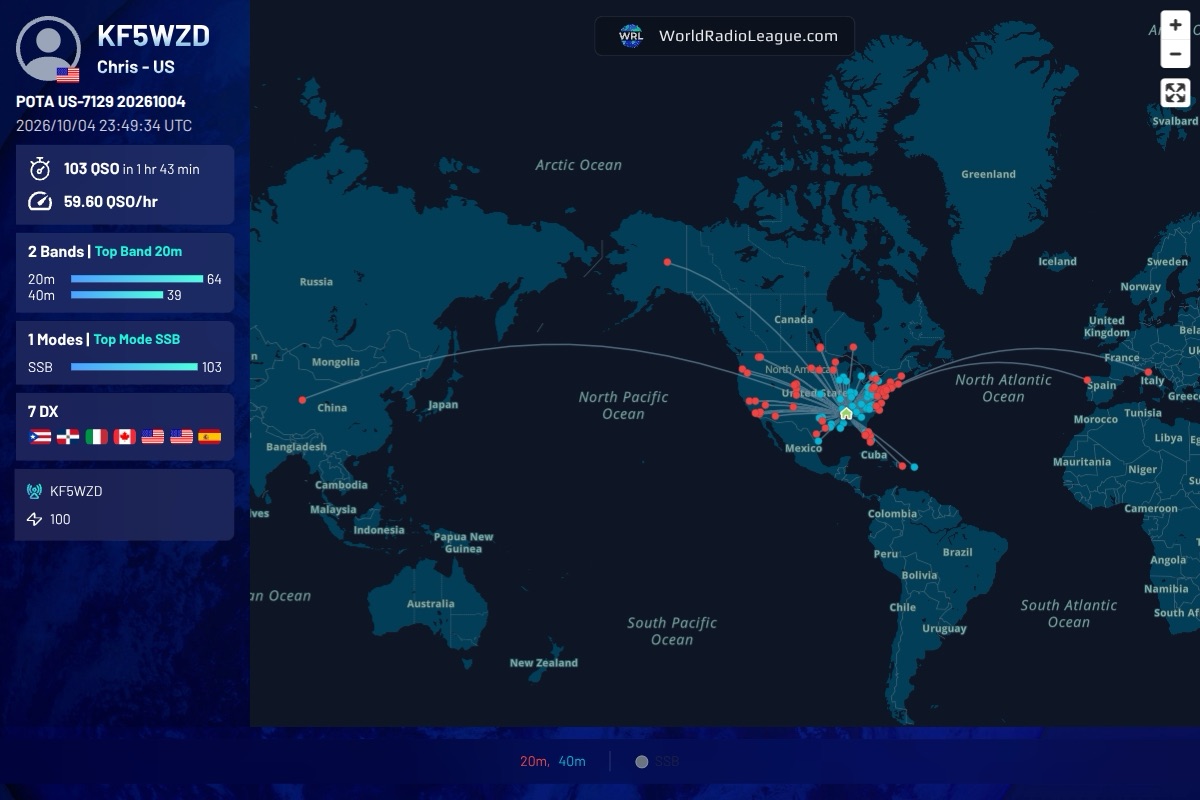
POTA Activation Report: Columbus Lake — US-7129October 4, 2026

Well, apparently I decided that spending a beautiful Sunday evening sitting beside a lake and talking to complete strangers was a good idea.

Which, when you think about it, is pretty much the entire hobby.

Today’s POTA activation took me to Columbus Lake (US-7129), where I got the station set up, fired up the radio, and started making contacts at 22:05 UTC (17:05 local).

This was an SSB-only operation on 20 and 40 meters, using my homebrew POTA Performer with a 17-foot vertical whip. It looks a little like a fishing pole, but today it was catching something other than fish.

And, as usual, the radio did most of the talking.

The Power Situation

I started the activation at 100 watts.

About halfway through, the battery started getting a little grumpy, so I dropped down to 50 watts.

The interesting part?

The contacts just kept coming.

This leads me to believe the other 50 watts were primarily there for morale.

Either way, 50 watts got the job done just fine.

Conditions

The weather couldn’t have been much better.

Overcast skies, a light breeze coming off the lake, and comfortable temperatures.

No sunburn. No sweating. No complaints.

Basically, POTA weather.

I may have finally figured out that activating a park doesn’t have to involve slowly roasting yourself beside a radio.

By the Numbers

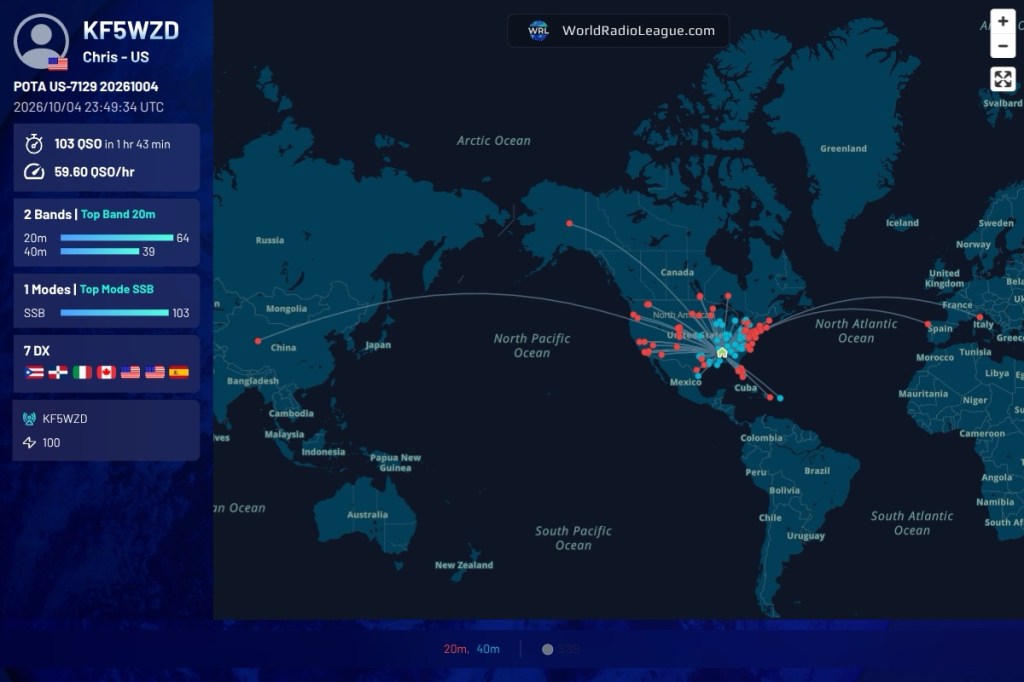
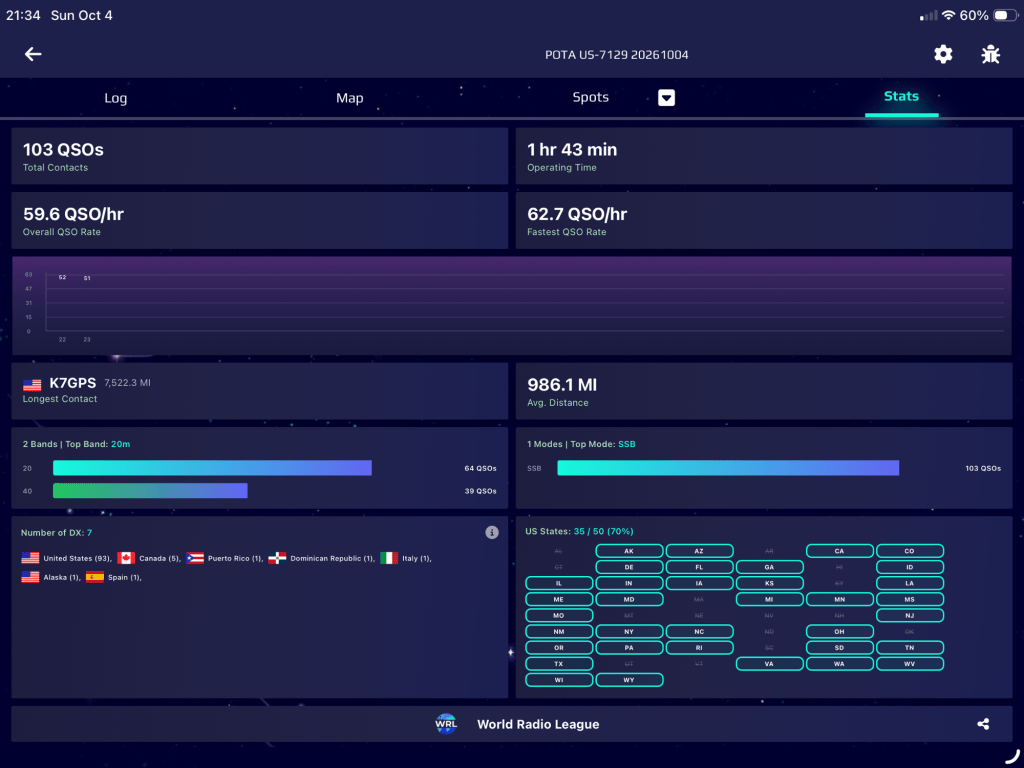
103 QSOs in 1 hour, 43 minutes

That’s an overall rate of 59.6 QSOs per hour, with a peak rate of 62.7 QSOs/hour.

  • 20 meters: 64 QSOs
  • 40 meters: 39 QSOs
  • 35 of 50 states: 70%
  • 7 DX entities
  • United States: 93
  • Canada: 5
  • Puerto Rico: 1
  • Dominican Republic: 1
  • Italy: 1
  • Alaska: 1
  • Spain: 1

The reported average distance was 986 miles, with the longest contact showing up as a rather impressive 7,522 miles.

Which brings us to…

The Contact That Took a Wrong Turn

My longest reported contact was K7GPS, showing up at 7,522 miles.

Now, unless K7GPS has secretly relocated to China, I’m going to go out on a limb and say the mapping software may have had a small disagreement with reality.

The map actually plotted the contact toward China.

So we have two possibilities:

  1. K7GPS has developed an absolutely ridiculous antenna system, or
  2. The mapping software had a rough day.

I’m going with #2.

That probably means the 986-mile average distance is inflated too, so we’ll just call it “roughly far.”

Close enough for government work.

The Coolest Contact

Spain.

Without question.

I had to listen several times to pull the station out of the noise, and it took a few attempts before we finally got the QSO into the log.

But we got it.

And it was absolutely worth the effort.

There’s just something satisfying about hearing a station from Spain buried down in the noise, repeating yourself four times, wondering if you’ve completely lost your mind…

…and then seeing the QSO go into the log.

Victory.

The States Still Trying to Avoid Me

The map showed a pretty good spread across the country, especially through the Eastern Seaboard and Midwest.

But there are still a few states that apparently haven’t received the memo.

I’m still looking for:

AL, AR, CT, HI, KY, MA, MT, NE, NV, NH, ND, OK, SC, UT, and VT.

Consider this your polite notice.

I’m coming for you.

Eventually.

Probably with a fishing pole.

And Finally… The Hunters

A big THANK YOU to everyone who answered the call today, especially those who hung in there when the bands got a little noisy.

And thank you to everyone who kept the spotting information updated and helped get the word out.

I had a great time activating Columbus Lake, but the truth is, POTA doesn’t work without the hunters.

You can sit in a park with a radio, an antenna, a battery, and a perfectly good excuse to avoid mowing the grass…

…but it’s pretty difficult to have a pileup when nobody is on the other end.

So thank you for making the activation what it was.

103 contacts, two bands, seven DX entities, one questionable trip to China, and a whole lot of fun.

Not a bad way to spend a Sunday evening.

Get Outside. Get On the Air. Get in the Park. But most importantly, HAVE FUN and Keep it Simple!!

73,
KF5WZD — Chris

POTA ACTIVATION Today

Good afternoon! Im headed to Columbus Lake to do a POTA Activation if anyone is interested in joining in person or on the air! I’ll be there approximately at 16:45 local time until the sun sets, the rains push me out, or the mosquitos! Hope to hear you on the air waves!

73 – KF5WZD

POTA: A Great Way to Get Outside and Get on the Air!

A Personal Journey Into Parks on the Air

Whether you’re a newly licensed General looking for a way to get your feet wet on HF, or you’ve been an Extra for years but have never taken your radio into the field, Parks on the Air (POTA) may be one of the best ways to get started.

You may have just earned your General license and are staring at the HF bands wondering where to begin. Or maybe you’ve been a ham for years, have plenty of experience making contacts from home, but have never tried setting up a portable station in a park.

Either way, POTA gives you a reason to get outside, put your radio to work, and experience amateur radio from a completely different perspective.

You can reach stations hundreds or even thousands of miles away, experiment with antennas and portable equipment, and learn skills that you simply don’t develop sitting in front of a radio at home.

And the best part?

You don’t have to be an expert to get started.

A New Series About POTA

This article is the first in a series about Parks on the Air (POTA)—and my personal journey into it.

We’re going to start at the beginning, with the operator who may be completely new to POTA, regardless of how long they’ve held a license.

As the series progresses, we’ll move into operating techniques, HF etiquette, choosing and setting up equipment, antennas, batteries and power, setting up in a park, and eventually some of the more technical aspects of getting the most out of your portable station.

Along the way, I’ll share what I’ve learned, what has worked for me, what hasn’t, and probably a few things I’ll learn the hard way.

The goal isn’t to turn you into an expert overnight.

It’s to give you enough information to get outside, turn on the radio, make some contacts, and learn along the way.

Because sometimes the best way to learn amateur radio is to simply go do amateur radio.

So, What Exactly Is POTA?

POTA stands for Parks on the Air.

The basic idea is pretty simple: amateur radio operators take their equipment into designated parks and other public lands and operate from there.

The operator in the park is called the activator.

The people who contact that operator are called hunters.

That’s it.

Well… mostly.

The activator sets up a station, finds a suitable frequency, announces that they are operating from a POTA park, and starts making contacts. Hunters listen for that station and try to work them.

And this is where POTA gets really interesting.

You don’t necessarily need a huge tower, a 1,000-watt amplifier, or an antenna farm that would make your neighbors start asking questions.

A portable radio, battery, wire antenna, and a little patience can be enough.

In fact, one of the things that makes POTA so much fun is figuring out just how little equipment you actually need to make contacts.

Why Has POTA Become So Popular?

POTA has done something pretty important for amateur radio.

It gives people a reason to get on the air.

For a new HF operator, one of the hardest things to overcome is simply making that first contact.

You may sit there listening to a band and hear experienced operators casually talking across the country. You hear callsigns, signal reports, grid squares, QSB, pileups, and a dozen other terms that may sound like another language.

Then you think:

“How exactly am I supposed to jump into this?”

POTA helps solve that problem.

When an operator is activating a park, other operators are specifically looking for them.

You aren’t interrupting someone’s long conversation.

You aren’t necessarily trying to break into a group of experienced operators who have been talking for 45 minutes.

You are participating in an activity where the whole purpose is to make contacts.

That makes POTA a fantastic training ground for new HF operators.

But it can also be a great way for the experienced operator to try something new.

Maybe you’ve been sitting at the same desk with the same radio for ten years.

Take it outside.

Put up a different antenna.

Run it from a battery.

See what happens.

You may be surprised at what that little portable station can do.

The First Thing You Need to Learn: Listen

This is probably the most important piece of advice I can give any operator getting started with POTA:

Listen before you transmit.

Before calling CQ, before answering someone, and especially before jumping into a pileup, listen for a little while.

Figure out what is happening on the frequency.

Is someone already talking?

Is someone calling CQ?

Is it a POTA activation?

Is there a pileup?

Is the frequency actually being used?

And, most importantly:

Is the frequency clear?

A quick “Is this frequency in use?” followed by listening is a good habit when establishing your own operation.

Remember, just because your radio isn’t showing a huge signal doesn’t mean nobody is there.

HF propagation can be strange.

You may hear a station perfectly while they can’t hear you at all. Another station may be weak one second and completely disappear the next.

Welcome to HF.

It’s part science, part art, and occasionally part witchcraft.

Finding a POTA Station

As a hunter, one of the easiest ways to get started is to find an active POTA station.

You can tune around the bands and listen for operators calling something like:

“CQ POTA, CQ POTA…”

You’ll often hear the park reference as well.

Once you find them, listen.

Pay attention to how they are handling contacts.

You may hear something like:

“K5ABC, you’re five-nine.”

The other operator may respond with their callsign and perhaps a signal report.

The activator acknowledges them and moves on to the next station.

It can happen very quickly.

Don’t worry if you don’t catch everything the first few times.

You’re learning.

How Do I Answer a POTA CQ?

This is where many new operators get nervous.

Don’t overthink it.

If the activator calls CQ, wait for them to finish.

Then give your callsign clearly.

Something as simple as:

“KF5WZD.”

That’s it.

Don’t give your entire life story.

Don’t explain what radio you’re using.

Don’t tell them about the antenna you built last Tuesday.

Don’t give them your dog’s name.

At least not yet.

If they hear you, they will usually come back with your callsign and ask for your signal report.

You give them the report they request, confirm the contact, and you’re done.

For example:

“KF5WZD, you’re five-nine.”

You might respond:

“Five-nine, thanks!”

The activator may then move on to the next station.

Congratulations.

You just made a POTA contact.

And somewhere, another ham just added another contact to their log.

What About a Pileup?

Eventually you’re going to find a POTA station that has attracted a lot of operators.

You’ll hear something that sounds like:

“K5ABC!”

“W4XYZ!”

“N7DEF!”

“KF5WZD!”

“W1…”

Everybody is calling at once.

Welcome to a pileup.

This can be intimidating at first, but there’s a technique to it.

Don’t yell louder than everyone else.

It usually doesn’t work.

Listen carefully.

The activator may pick out a partial callsign, a prefix, a suffix, or a particular station.

If you hear:

“The station ending in WZD, go ahead.”

That’s your turn.

Give your callsign clearly and then stop transmitting.

If they don’t hear you, don’t immediately transmit again.

Let the next station have a chance.

The activator will come back around.

This is where good operating etiquette becomes really important.

POTA Isn’t a Contest to See Who Can Transmit the Loudest

One of the great things about POTA is that it can teach you something that isn’t always obvious when you first get on HF:

Good operators know when not to transmit.

If the activator is talking, don’t transmit over them.

If someone else has been recognized, don’t transmit over them.

If you didn’t hear your callsign, don’t assume they were talking to you.

And if you make a contact, get out of the way so someone else can make theirs.

Remember that there may be dozens of operators trying to work the same station.

Your contact may take 10 seconds.

Someone else’s may take 10 seconds.

Multiply that by 50 or 100 operators and you can see why keeping things short and efficient matters.

Good POTA operators aren’t necessarily the ones with the biggest signals.

They’re often the ones who listen, understand what’s happening, and know when it’s their turn.

That’s a lesson that applies to amateur radio far beyond POTA.

And Then There’s the Other Side: Activating a Park

Eventually, you may decide you want to try the other side of POTA.

Go activate a park.

This is where POTA really starts getting fun.

You don’t need an elaborate setup.

You can take a small radio, battery, antenna, coax, and a chair into the park.

Set everything up.

Get your antenna in the air.

Turn on the radio.

Find a clear frequency.

Listen.

Then call CQ.

You might start with something like:

“CQ POTA, CQ POTA, this is KF5WZD, activating [park reference].”

And then…

Wait.

Maybe nobody answers.

Call again.

Still nothing?

Call again.

Then suddenly:

“K4…”

And you’re off.

The first few contacts can be slow.

Then you may get five stations calling at once.

That’s when you discover another important HF skill:

Learning how to control a pileup.

But don’t worry about being perfect.

You’ll get better with every activation.

And that’s another great thing about POTA.

Every activation teaches you something.

Maybe your antenna wasn’t high enough.

Maybe your battery didn’t last as long as you expected.

Maybe you discovered that sitting in the direct Mississippi sun with a black radio case wasn’t your greatest idea.

Maybe you learned that the 20-meter band was packed while 40 meters was wide open.

That’s all part of it.

POTA Is More Than Collecting Contacts

It’s easy to get caught up in the numbers.

How many parks have you worked?

How many states?

How many contacts?

How many bands?

Those things can be fun, and there’s nothing wrong with chasing the numbers.

But I think POTA’s greatest benefit is something else.

It gets people on the air.

It gives new operators a reason to learn their radios.

It encourages people to experiment with antennas.

It gets us outside.

It introduces operators to HF.

It teaches operating etiquette.

And perhaps most importantly, it gives experienced operators an opportunity to help new operators learn.

I’ve seen plenty of operators get their first HF contact through POTA.

I’ve also seen experienced hams become more confident operators simply because they started taking their radios into the field and putting them to work.

And that’s something worth encouraging.

Where Do I Find POTA Activations?

Once you understand what POTA is, the next question is probably:

“Okay, where do I find these activators?”

There are several websites and tools that can help you find parks that are being activated, see what bands and modes are being used, and even follow an activation as it happens.

We’re going to save that discussion for the next article in this series, where we’ll look at finding POTA activations, figuring out where they are operating, and—most importantly—how to actually make that first contact.

We’ll also talk about some of the tools available to hunters and how to use them without becoming completely dependent on a computer or phone.

Because eventually, you should be able to sit down at your radio, spin the dial, hear “CQ POTA”, and know exactly what to do.

That’s where the fun really starts.

You Don’t Have to Have the Perfect Station

If you’re a newly licensed General and HF seems intimidating, don’t let it scare you away.

And if you’ve been licensed for 20 years but have never activated a park, don’t let that stop you either.

You don’t need the perfect radio.

You don’t need the perfect antenna.

You don’t need a huge amplifier.

And you certainly don’t need to know everything before you start.

Start with what you have.

Learn the basics.

Listen.

Ask questions.

Pay attention to how experienced operators conduct themselves.

Make a few contacts.

Then make a few more.

Before long, you’ll find yourself explaining to another operator how a POTA pileup works.

That’s how the hobby grows.

Get Outside. Get On the Air.

POTA has given thousands of amateur radio operators a reason to get outside, get on the air, and make contacts.

For some, it may be their first real introduction to HF.

For others, it may be the excuse they’ve needed to finally take that radio out of the shack.

Either way, POTA gives us something pretty simple:

A reason to go play radio.

And honestly, that’s what amateur radio should be about.

Get Outside.

Get On the Air.

Get in the Park.

But most importantly…

HAVE FUN and Keep it Simple!!

73 KF5WZD – Chris