
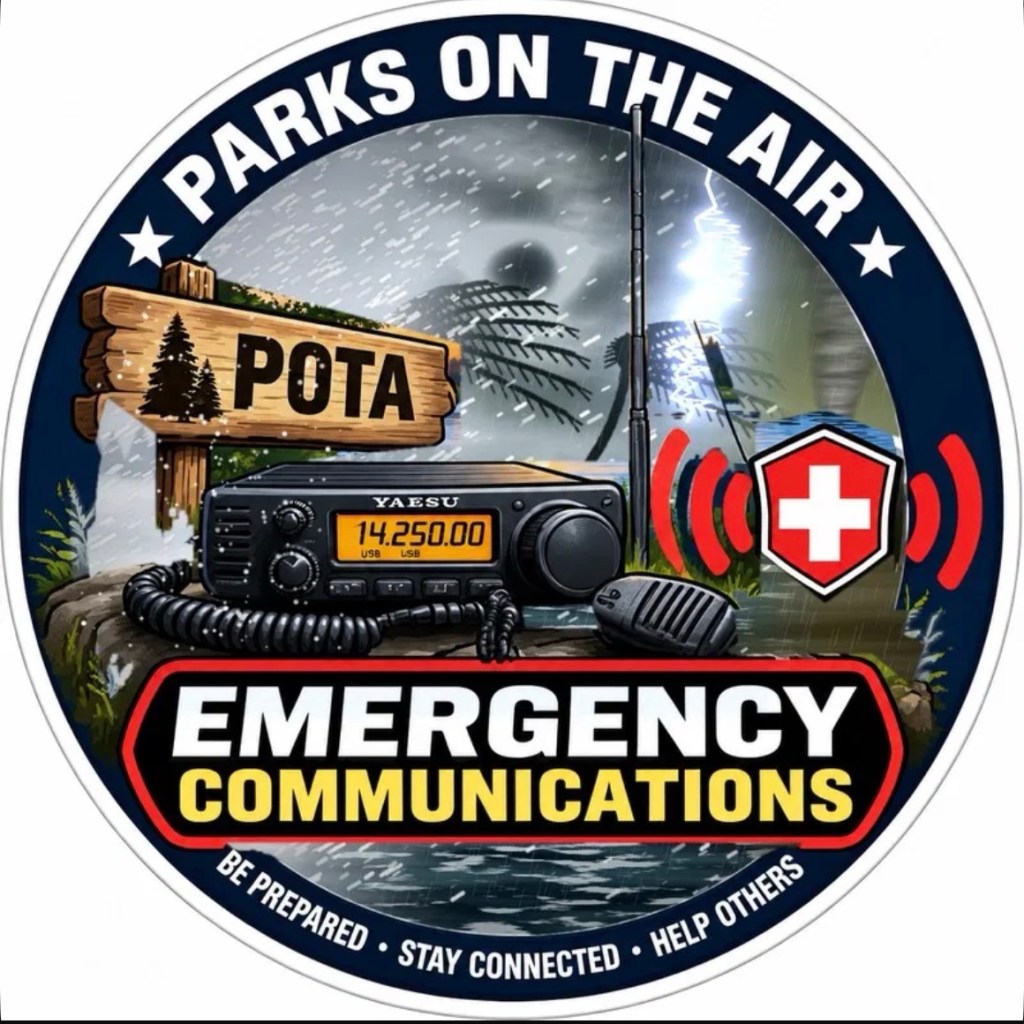
POTA Guide: Mother Nature Doesn’t Care About Your QSO Count
A personal journey into Parks on the Air
With a hurricane approaching the Gulf Coast, it seems like a good time to talk about something that should be part of every POTA activation plan: weather awareness and responsible use of the amateur radio bands.
We spend plenty of time discussing radios, antennas, batteries, coax, and how to squeeze one more contact out of an activation. We research parks, check propagation, and watch POTA.app for spots.
But how often do we stop and ask ourselves two simple questions?
What’s happening with the weather, and what’s happening on the frequencies I’m planning to use?
Both questions deserve an answer before we throw a wire in a tree, extend a vertical, and start calling CQ.
Mother Nature Gets the Final Say
Let’s start with the obvious. If severe weather is approaching, your activation can wait.
Check the forecast before leaving home. Keep an eye on watches and warnings, and continue monitoring conditions while you’re in the park. Remember that weather conditions can change quickly, especially around thunderstorms, strong winds, and tropical systems.
A beautiful morning beside a lake can turn into a very bad afternoon before you’ve finished your second cup of coffee.
Don’t forget that trees, exposed locations, lakeshores, and temporary antenna supports all present additional concerns when severe weather moves in. If conditions become unsafe, shut down and leave when it is safe to do so.
That rare DX contact isn’t worth becoming the subject of somebody else’s emergency report.
The Hurricane May Be Hundreds of Miles Away. Your Signal Can Reach It.
Here’s where things get interesting for us HF operators.
You might be sitting comfortably in a Mississippi state park while a hurricane threatens communities along the Gulf Coast or farther away in the Caribbean. The sun might be shining at your location, the birds might be singing, and your biggest concern might be whether the 20-meter band will cooperate.
Meanwhile, amateur radio operators in the affected region may be passing weather observations, emergency information, or messages for people trying to contact loved ones.
Amateur radio is more than a hobby during these situations. Established emergency networks can help relay weather reports, coordinate relief efforts, and provide communications when ordinary infrastructure fails.
And here’s the important part: you don’t have to be in the disaster area to interfere with communications taking place there.
HF propagation can carry your signal far beyond your local surroundings. A frequency that sounds completely quiet at your picnic table might be in use by a station you simply cannot hear.
You could be calling CQ for another POTA contact while an emergency net is trying to pass information somewhere down the band.
Nobody intends to cause a problem. But good intentions don’t prevent interference.
Know Before You Transmit
Before heading out for an activation, take a few minutes to research current emergency communications activity.
During hurricane season, the Hurricane Watch Net is an important resource to know about. Its commonly used frequencies include 14.325 MHz on 20 meters and 7.268 MHz on 40 meters, depending on propagation and whether the net is active.
These are examples, not a complete list of emergency frequencies. Other regional and international emergency nets may be activated, and their operating frequencies can change with the situation.
Check current information from the ARRL, the Hurricane Watch Net, and relevant emergency communications organizations before operating. Pay particular attention when a hurricane, wildfire, major flood, or other disaster threatens populated areas.
And don’t limit your awareness to the frequency where you intend to operate. Emergency traffic may be taking place on nearby frequencies, other bands, or digital modes.
If you hear an emergency net or learn that a frequency is being used for emergency communications, stay clear and give those operators room to work. Don’t assume that a frequency is available simply because it isn’t listed as a calling frequency or because your radio isn’t picking up any activity.
When emergency communications are underway, making room for them is more important than making another contact.
“But I Can’t Hear Anybody!”
This is where antenna selection and setup become more important than many operators realize.
An antenna doesn’t hear every station equally well. Its height, orientation, polarization, radiation pattern, and the propagation conditions all affect which signals reach your receiver and how strongly they arrive.
Your portable vertical may hear one station clearly while missing another station that is communicating on the same frequency from a different direction. A low wire antenna may perform very differently from a higher antenna, depending on the band and the distance involved.
The same applies to your transmitted signal.
Not hearing a station does not mean that station cannot hear you.
This is one reason we should listen carefully before transmitting, use appropriate operating practices, and pay attention to current band conditions. A quiet receiver is not a guarantee of a clear frequency.
And remember that changing antennas, adding power, or moving to another band doesn’t automatically solve the problem. Responsible operating begins with understanding what’s happening on the air.
A Little Homework Goes a Long Way
Before your next activation, add a few items to your normal checklist:
- Check the weather forecast and any watches or warnings for your destination.
- Identify the emergency and weather nets that may be active because of current events.
- Verify their current frequencies and operating status using reliable, up-to-date sources.
- Listen carefully before transmitting, and continue monitoring conditions as you operate.
- If you encounter emergency traffic, stop transmitting on that frequency and move elsewhere when appropriate.
- If severe weather threatens your location, prioritize your safety over completing the activation.
You don’t have to become an emergency communications expert to be a considerate operator. You simply need to be aware that other people may have a much more important reason to be on the air than collecting a park reference.
We’re All Sharing the Same Bands
One of the great things about amateur radio is that a signal sent from a quiet park can connect us with people across a state, across a continent, or across an ocean.
That same capability comes with a responsibility.
The operator trying to complete a POTA activation, the amateur passing a weather observation, and the emergency net coordinating assistance are all using the same radio spectrum. We need to be mindful of one another, particularly when severe weather threatens lives and communities.
So, when you plan your next activation, check your batteries, pack your coax, choose your antenna, and check the bands.
But check the weather, too.
Because the goal isn’t simply to get outside, get on the air, and get in the log. It’s to do all of that while being a responsible member of the amateur radio community.
And if Mother Nature decides that today isn’t your day, there’s always tomorrow.
The park will still be there. The radio will still work. And your log will survive missing a few QSOs.
Useful Resources
Before heading out for your next activation, bookmark these resources. They can help you stay informed about weather threats, emergency communications, and responsible operating practices.
- ARRL — Ham Radio During Hurricane Season: Guidance and information about amateur radio during hurricane season.
- ARRL — Operating Resources: Amateur radio operating information and useful references.
- Hurricane Watch Net — www.hwn.org: Information about the net, its mission, activation status, and operating frequencies.
- National Hurricane Center — www.nhc.noaa.gov: Official tropical cyclone forecasts, advisories, and updates.
- National Weather Service — www.weather.gov: Local forecasts, watches, warnings, and hazardous weather information.
Remember that emergency net frequencies and activation status can change. Always verify current information rather than relying on an old frequency list or a saved note in your radio.
A few minutes of preparation before an activation can help you avoid unnecessary interference and make better decisions when conditions change.
Get Outside, Get On the Air, Get in the Park, but most importantly, HAVE FUN and Keep it Simple!!
73 KF5WZD – Chris


